Cerini Bess died on June 22nd, 2023 after a years-long struggle with dementia.
She was 86. She leaves 2 sons, Tim Bess and Piet Bess and grandchildren Nigel Bess
and Delphina Wedell along with nieces Anne Anderson, Catherine Creely-Hodges,
Elizabeth Creely, and Emily Creely and nephew James Creely, close to her because of
her lifelong relationship with her brother Christopher “Kit” Creely, who died in 2007.
Cerini was born in Los Angeles, a couple days before Christmas on December 20th, 1936.
She complained that this meant she only received one gift for both occasions. She grew up
in the middle of the Great Depression, the daughter of bookstore owners Bunster Creely and
Virginia (Wellendorf) Creely. They lived in South Pasadena as a young couple. Bunster
joined Virginia's family’s business, the Holmes Book Company, and later opened the Abbey
Bookstore on Los Angeles' famed Bookstore Row.

Cerini and her brother Kit were very close despite their eight-year difference in age.
She talked about how her brother cared for her, and how she would constantly tag along
after him and his friends. One of her favorite stories was about when he mischievously gave
her a chile, then watched in horror as a single tear rolled down her cheek. He carried her
around on his shoulders for the rest of that day, as she described it.
In her early childhood, Cerini lived in Altadena, on Arroyo Ave where the 210 freeway
runs now. Her mother sought out a school there that
was not almost all white, and she hiked in the nearby hills with her friend Freddie Pigg.
After moving to Newport Beach in 1946 with her parents, Cerini lived on Balboa Island
in one of the area's early beach shacks. Her mother, “Diddie” divided bedrooms from
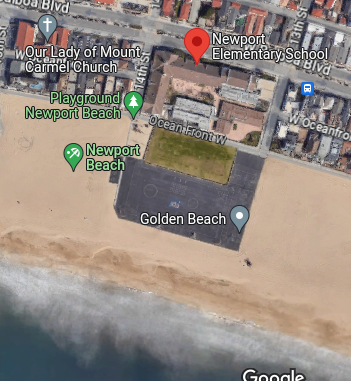
common areas using rattan blinds. Cerini attended Newport Elementary school where
she played on the beach, and gained her lifelong love of the ocean. These days, the playground
is on the beach. Back then, the beach was the playground. Cerini told of how she did well in all
subjects except recess. She propagated her schooldays attitude in raising her sons. “It’s not a
prison,” she said, “Leave whenever you want”, and, “Keep on hitting them until they start
crying and stop fighting.”
At that time, people lived on Balboa not only because it was pretty, but also to make a living. Cerini
had memories of the small fishing community that existed in Newport beach, before the wide-spread
development of the fifties and sixties. She sometimes borrowed a dory belonging to a local fisherman.
The boat was indescribably heavy, but the man would push it with, as she told it, one huge hand down
the sand and into the surf. She and a boy she knew would paddle it around in what I understand to be
the ocean off Balboa peninsula, rather than the calmer waters of Newport Bay.
As a teenager, when her parents lived inland on Irvine Avenue, she attended Newport Harbor
High School. In a photo of the entire class lined up there, she is one of the few girls with raven hair.
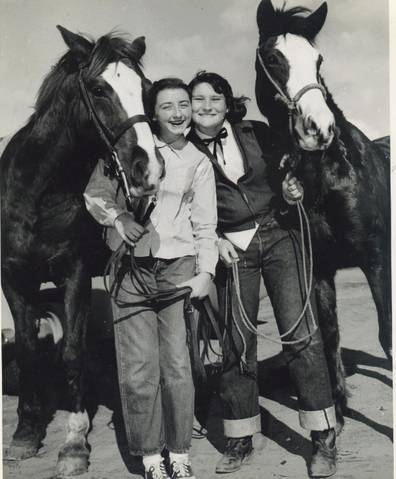
One of her favorite stories in later years is about how an owner of a stable near her home would let Cerini
and her friend Mary Lee borrow her horses to exercise them. They explored the extensive lands of the
Irvine Ranch, consolidated in the 1860s from 3 Spanish land grants. One favorite destination was "Shark
Island", which may be the same as Harbor Island near Pacific Coast Highway. Cerini and her friends
would swim the horses out to the sandbar. Now it is connected to the mainland and covered side to side
in houses with their own boat docks.
Cerini also spent some time living with her maternal grandmother Mabel nee Holmes on the high-status
Longridge Road in Oakland. Mabel, or “Ma”, as she is still known to her family, was a formidable woman
with a high temperament, a loving grandmother who helped raise Cerini.
Ma had pet names for her grandchildren: Impy for Kit and Dweetsy for his little sister, which Cerini
confided in her last years, after keeping it to herself all her life. The economic contrast between Diddie’s
and Ma’s households may give some clue to why Cerini lived in Northern California for a while, or it
may indicate other difficulties in her parents’ household.
Parts of the family lived in the San Francisco Bay Area and others in the greater Los Angeles area.
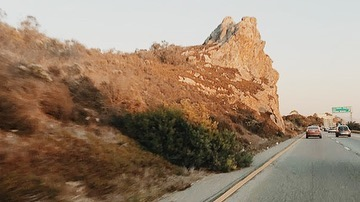
They have driven between the two on Highway 101 for easily more than 100 years. Cerini spent nearly
20 years at the end of her life living at the middle of that road, in Pismo Beach, finding a connection with
the Pacific first established in Newport. In her last years of life, she remarked on the landmark this rock,
in Pismo, had provided through her whole life. It stands smack dab (a favorite phrase of hers) in the
middle of the 101.
After high school, Cerini enrolled at Orange Coast College, the local community college, and then transferred
to UC Berkeley. Her mother had lived in Berkeley, and had attended the university until Kit’s birth intervened.
Cerini was a member of Delta Zeta sorority, and remained in contact with several of her sisters into later life.
While at Cal,
she also started working as a ticket agent at TWA, and, in an early instance of remote learning, passed
a history class there without the professor knowing who she was. Her free flights allowed her to be present
to take the exam, but she had arranged with others to share their notes while she was away, and the instructor
was left asking the class who this Cerini Creely was who had turned in an excellent final assignment.
It was at Cal that Cerini met Dave Bess. As she told it, when they went out on one of their first dates
on a Friday during Lent, he was relieved that she ordered a hamburger. He does not corroborate the
story. Her name indicated that her family was Irish, and if she had been Catholic, then meat would
have been forbidden. As it turned out, it was her grandmother’s Episcopalian affiliation that she had
settled on. Bunny, her father, who attended mass all his life, had been excommunicated for marrying
a Protestant.
After college, Cerini did a walkabout, touring England, Germany, Italy and other European countries
on bicycles and trains, crossing the Atlantic on a ship. This gap year is a tradition that subsequent
generations have carried on. She prized her memories of nice German boys at the youth hostel
stripping to their Lederhosen and taking sponge baths while her American companions remained
sweaty and smelly because there was no shower. She gained access to her friend’s Italian relatives’
kitchens connecting to her great grandfather’s heritage. He was Francisco Cerini, a Florence
native who had immigrated to San Francisco in the 1850s. His surname was the source of Cerini's given
name, which she shared with at least one other family member.
Cerini married Dave in California while he was in the Navy, and they drove cross-country to Athens
GA where he was stationed. She followed him to Japan to his destroyer’s home port. In a significant
departure from common practice, they lived “on the economy”, or off base. This was out of the
ordinary not only because it was a decade and a half after WWII, but also because of cultural attitudes
among military families.
Cerini worked hard on learning Japanese, and read extensively about the culture and history of the
place, still evidenced by her bookshelf today. Living in a traditional house with walls she described
as made of rice-paper, they furnished it with antiques they bought locally. These antiques still
furnish their homes. When a typhoon approached, Dave’s ship went to sea to avoid damage in port,
and Cerini hunkered down as much as one could in such a lightweight dwelling. Interested in what
exactly a typhoon was, she was taken aback to find it equated in the dictionary with a hurricane,
not part of her experience in California, but a concept that really made her sit up and take notice!
The Navy took David to Bremerton WA, and then to Oxnard CA. During David’s last few months
in the Navy in Southern California, she gave birth to Peter (later Piet). In both places, they lived on
or near the water: in Washington, they could even go clamming for their dinner in the front yard!
After David’s discharge, around the time Timothy was born, his work took them to Los Angeles,
and then to Berkeley again, where he studied for his Master’s degree at Cal. He started teaching at
Cal Poly Pomona, close to her brother’s young family in Costa Mesa.
Cerini’s prodigious energies went into childrearing and running a household. She and David bo
ught a 1906 Craftsman style house on Kingsley Avenue in Pomona with a modern 1970s linoleum
kitchen and a laundry chute from the upper floors. They painted the kitchen cabinets broadly in
bold colors, and entertained in a living room with a plate glass front window, hardwood floors,
built-in varnished wood cabinets with leaded glass doors, and an immense “oriental” style rug.
A large Marimekko print greeted guests, and the cane backed couch’s cushions were re-upholstered
in lime-green wet-look vinyl. Beautiful mid-century "architects" chairs were positioned in the living
room, in front of the fireplace, and a gorgeous wooden surround in the formal dining room was the
site of many family dinners.
The house was regarded by her nieces and nephews as a grand place, who explored every square inch
of it, although they mostly avoided the back stairs and cellar, as these were considered to be spooky
and possibly haunted.
The family vehicle was a 1972 Volkswagen Westfalia camper. This served not only as a camper in
its own right, but also as a way to go backpacking, the 1970s fad based on new, lightweight gear.
They started with well-equipped, Sierra Club standard, 10-essentials day hikes, and then progressed
to real backpacking trips in the High Sierras. Goose-down sleeping bags were usually the only thing
bought new-- the rest of the large items she found thrift shopping, something she indulged in all her
life and passed on to Piet. She found Boy Scout troops for the children based on their focus on
backpacking, not car-camping.
In the Pomona house, she raised not only her 2 sons, but also, at various times, foster sons George
Berletich and Kenneth Herrera, now known as Philip Henley. Her nieces and nephews were
sometimes in her care, sometimes to attend swim lessons, which looms large in her nephew
James’s memory. She showed him at about kindergarten age that he could swim to her arms
unaided in the cold, overcast summer morning waters of the Chaffey High School pool. She
regarded swimming as a crucial life skill, not surprising for someone who had grown up on
the beach. Her sons also took mandatory swim-lessons in the summers.
While raising her sons to become dyed in the wool swimmers had mixed success, another
important life skill, bicycling, stuck with her sons, one of whom raced mountain bikes and
the other who commutes on a bike. She raised them to get out in traffic and ride according to
the rules that apply to cars. In about 1970, she took both sons, along with a somewhat nervous
foster son George, to Santa Barbara on bikes. Tim, 7, only had one gear and a coaster brake.
The others had 3 speeds. She admonished her sons not foolishly to buy bicycles new: there
were plenty of good bikes out there in thrift shops. Often, a coat of spraypaint was all that
was needed.
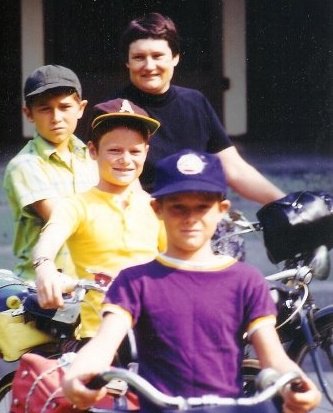
From front: Tim, Peter, worried looking George, Cerini
Luggage on the trip was canvas suitcases bungeed to luggage racks. The route west of Newhall
led up oil company access roads. She probably wasn’t supposed to be there, but her map showed
a road, so she took it. It became clear that this was a dead end, so she had the boys lift their
baggage and then their bikes over a barbed wire fence. So far, so good, but the route north to
the highway crossed a motorcycle park. The riders there found it amusing to say the least to see
a family of cyclists pushing heavily laden bikes through the sand as they buzzed past. This episode
demonstrates an obstinate, anarchic aspect of Cerini’s personality that she has successfully passed
on to at least one of her sons, and nieces Elizabeth and Emily.
About the time Cerini’s sons were in junior high school, as it used to be called, she took on the
daunting task of becoming a lawyer, following in her grandfather James Creely and uncle Frank
Creely’s footsteps. She studied at LaVerne College’s law school, and edited the law review there.
The children were left in the law library to do their homework, and sent to Del Taco to buy dinner.
She passed the Bar Exam in 1976: Dave had taken the boys to the Montreal Olympics and the
bicentennial celebrations in New England to get them out of her hair, and she rejoined them for the
return trip.
For the first time since starting a family, Cerini took a job outside the home at a law firm in Covina,
connecting to the scouting leaders whose troop she would send Peter and Tim to. Around this time
of increasing independence, she separated and later divorced from Dave. Cerini stayed in the house
in Pomona as the boys finished high school.
It was at this point that Cerini re-connected with her Christian faith, and began to participate in a
singles group at an evangelical church. Here she established some of the stronger friendships of
her later life with women who were staunchly Christian and found themselves in search of a partner.
While these relationships, and shared worship, nourished her soul, she remained single.
Cerini left the Covina firm to start her own practice, focusing on cases relating to family law, but
she found she didn’t generally enjoy the company of attorneys. She went to work for Jet Propulsion
Laboratory in Pasadena in contract administration. She was thrilled to be involved in JPL’s space
exploration projects, sometimes witnessing momentous successes live with the other employees
and collecting souvenirs of NASA projects.
Cerini stayed at JPL until she was nearly 70. She had invested in rental properties in Arroyo Grande,
near Pismo Beach, often staying there in local motels amid the tang of the salt air and the sound
of the surf. With Diddie’s death in her 90s, Cerini was able to buy a small mid-century house
about 200 yards from the sea bluff in Shell Beach, part of Pismo where she lived out almost 20
years, attending Oak Park Christian Church in neighboring Grover Beach.
While continuing to visit thrift stores, Cerini also used this time to return to her youthful wanderlust,
stocking her Lexus with Triple-A maps of California from Temecula to Berkeley, through the landscape
she knew best: grassy hills, dotted with live oaks on one side and the pacific ocean on the other. These two
landscapes lay on either side of her through the window of her car as she drove through the central coast.
Cerini remained a voracious reader through this time, her tastes running toward spy thrillers, and
engaged actively with the stock market, making notes in the margins of newspapers and magazines,
and staying on top of her personal finances. Sadly, dementia made all this more difficult, and in 2020
it was so hard for her to organize her life that she agreed to live with Tim in Rancho Cucamonga,
alternating between watching TV and enjoying the vista of sky and trees on his patio. A fall sent
her to a convalescent home near Tim’s house where he was able to supervise her care for 2 more
years before death took her.
In conclusion, in Elizabeth Creely's writing voice: She was a major influence in the culture of her family, and passed on a deep appreciation of all of
California's landscapes, a belief in the power of the ocean, a reverence of horses, and a veneration
of books and the importance of literacy.
Coda, December 2025: When I went to the office of California Properties in Arroyo Grande, I informed
of the reason for me visit, to give my contact information for the disposition of Cerini's properties. The
woman there exclaimed happily that she thought I looked familiar, that I bore a strong resemblance to Cerini.
She spoke of how nice my mother was, though she was quick to follow with the fact that she was also
"stern". It was good to connect to Cerini's mother this way.

No comments:
Post a Comment